
Sudan central bank private payment switch sparks debate
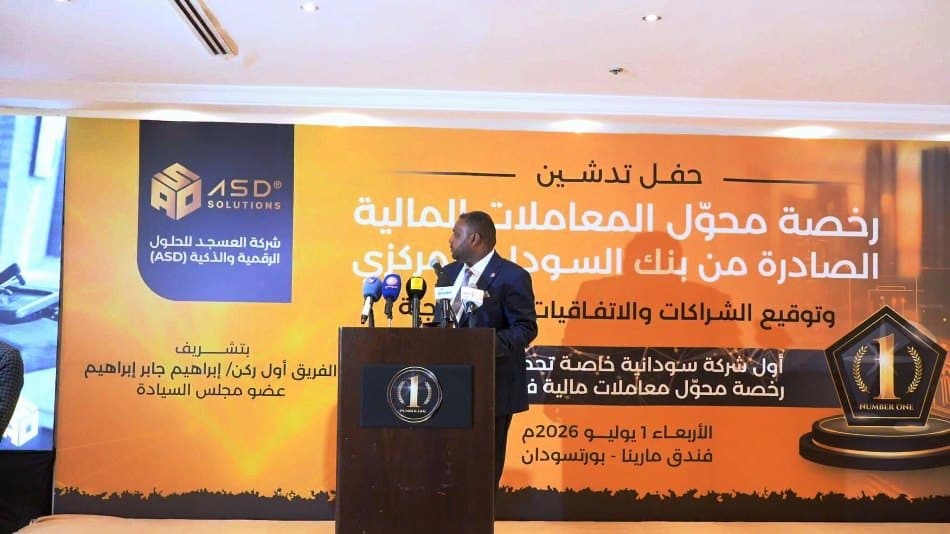
JULY 2, 2026 (KHARTOUM) – The launch of a new digital platform by Al-Asjad Company for Smart and Digital Solutions in Sudan has sparked widespread controversy in economic and banking circles, amid questions regarding the company’s recent establishment and potential links to the United Arab Emirates.
The official launch of the new digital platform took place in Port Sudan on Wednesday, with representatives from the Sovereign Council, the Bank of Sudan, the Banking Association, bank directors, and experts in attendance. This followed the platform obtaining a financial transaction switch operator license from the Central Bank of Sudan.
The platform aims to develop daily financial transaction mechanisms by linking Sudanese banks to a unified central platform. This enables immediate financial transfers, retail payments, bill and government service payments, and bank card management.
Questions have emerged regarding the company’s background, with reports circulating about an indirect connection to the UAE through Ayman Abu Jaibain, the former president of Al-Merrikh SC, who is married to Asjad Al-Kazim, the platform’s manager.
A senior banking source close to the Bank of Sudan told Sudan Tribune that the bank has recently granted licenses to several national companies to operate as Financial Switch Operators. These include Bright Technologies, Al-Asjad Company for Digital and Smart Solutions, Nahda Technology Company, and Sudapost.
The source explained that issuing these licenses responds to the banking and financial sector’s need to expand electronic payment services and enhance access. It achieves this by providing connectivity services for banks that do not own their own switches, enabling them to offer modern retail banking services, support point-of-sale operations, issue bank cards, and connect ATMs.
It also links telecommunications companies, electricity providers, and government fee-collecting entities to the national payment system, enabling direct bank-to-bank transfers and providing the technical environment to connect financial technology (FinTech) companies with banks.
The source added that licensing private switches represents a major step toward expanding financial inclusion and providing digital services to wider segments of citizens and institutions. It also contributes to the spread of electronic payment methods and to the provision of digital points of sale for merchants, thereby improving economic efficiency and reducing reliance on cash.
The source emphasized that granting licenses for private switches does not infringe upon the sovereign role of the Central Bank of Sudan, nor does it conflict with its ownership of the national switch. The Central Bank remains responsible for managing settlements between parties and exercising oversight and supervision of the payment system, while private switches operate within the regulatory framework set by the Central Bank.
The source noted that allowing specialized national companies to operate in this field fosters competition and innovation, transfers global expertise in modern payment systems, opens opportunities to employ and qualify national talents, and promotes a digital financial culture.
The source clarified that utilizing private financial switches alongside national systems is not a unique experiment but is implemented in several countries, including South Africa, Nigeria, Kenya, and Nepal. The source stressed that issuing these licenses falls within the central bank’s strategy to develop the electronic payments sector, enhance financial inclusion, and support innovation, while fully maintaining its regulatory and sovereign role.
For his part, digital transformation expert Mohamed Al-Khair told Sudan Tribune that Asjad Al-Kazim previously worked as a marketing manager at the Sudanese Jordanian Al-Jazeera Bank. Following her resignation, she established a company specializing in financial services in 2025. She then applied to the Central Bank of Sudan for a financial transaction switch operator license, receiving initial approval before recently securing the final license.
Al-Khair added that the company is newly established, raising questions about the scale of its technical and financial capabilities, its cumulative experience, its capacity to secure data, its ability to meet operational and anti-money laundering requirements, and its ability to fulfil the major technical prerequisites required for financial switch management.
He emphasized that the company will not replace the Electronic Banking Services (EBS) company, which acts as the national switch. He explained that the private sector has simply been permitted to obtain licenses for private switches linked to banks, provided this is done via connectivity with the EBS company affiliated with the Central Bank of Sudan.
In turn, economic analyst Mohamed Al-Nayer told Sudan Tribune that granting the transaction switch license represents a progressive step in financial technology, noting that the private sector is capable of contributing to the development of the banking sector.
However, Al-Nayer believed that the Central Bank of Sudan could have developed the first unified payment mechanism through EBS. This would have helped unify payment systems across banks by utilising their capabilities for managing electronic clearing and debit/credit operations, thereby enhancing integration and strengthening banking applications through a unified channel.
Conversely, banking analyst Waleed Dalil criticized the issuance of licenses for private digital switches, arguing that there is a trend to market what he described as individual-owned intermediary digital switches as a technical necessity to relieve pressure on the national switch.
Dalil said this approach requires a rigorous technical and legal review because, in his view, these switches provide no real added value and instead impose additional costs on the financial system.
He added that claims to ease pressure on the national switch lack a technical basis, since digital payments occur instantaneously. This renders the intermediary switch a mere transmitter of transactions, with no active role. He warned that conducting transactions outside the national switch could impact real-time monitoring and weaken the anti-money laundering framework.
He also argued that the presence of a private intermediary would not prevent a single point of failure, as its operation remains tied to the national switch, while banks and customers bear unjustified additional costs.
Dalil stressed that the issue also concerns trust and sovereignty, noting that entrusting bank account data to privately owned platforms raises information security questions. He called for efforts to focus on supporting national technology companies in developing innovative financial applications rather than on establishing intermediary switches.
In response to these criticisms, Al-Asjad Company for Digital and Smart Solutions issued a clarifying statement affirming that the financial switch represents a national infrastructure for payment systems. It connects banks, financial institutions, and payment service providers through a unified technical platform, enabling financial transfers, payments, and settlements to be executed securely and rapidly in accordance with regulations set by the Central Bank of Sudan.
The company explained that the financial switch operator license is not an exclusive privilege but rather a regulatory license granted by the central bank to any company that meets technical, financial, security, and regulatory requirements. It noted that it was the first private company to fulfil these conditions and secure the license, while the door remains open for other qualified companies.
It added that international best practices, supported by the World Bank, are based on the central bank assuming regulatory, supervisory, and oversight tasks, while the licensed private sector handles the development and operation of infrastructure and technical solutions to foster competition, innovation, and service efficiency.
The company pointed out that the central bank’s subsequent issuance of licenses to other companies confirms that the license is not a monopoly for any entity but is granted to anyone who meets the approved regulations and standards.
The company concluded that obtaining the license is a national responsibility that requires adherence to the highest technical and regulatory standards. It pledged to work in partnership with the Central Bank of Sudan, banks, and financial institutions to build a modern and secure national payment system that supports innovation and serves the Sudanese economy.