
Two-thirds of surveyed Sudanese households lack salaried workers, CARE says
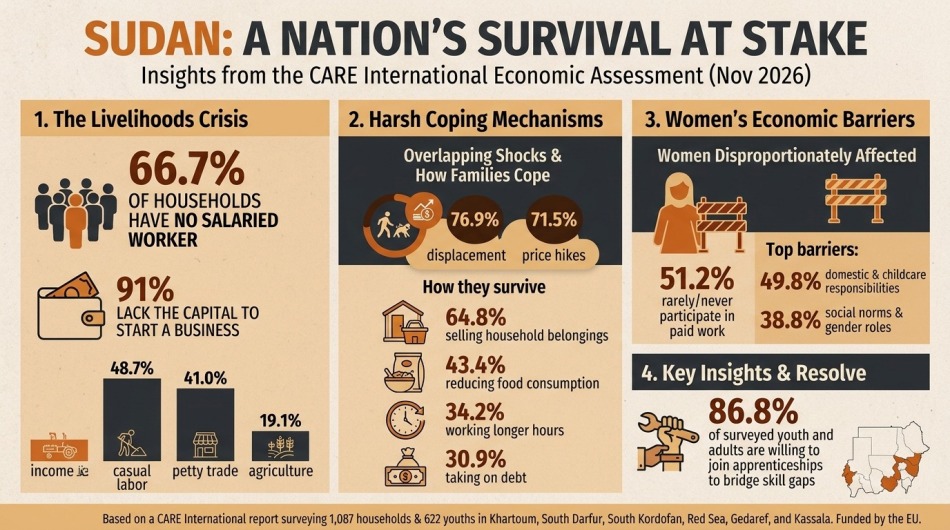
November 24, 2026 (KHARTOUM) – About two-thirds of surveyed Sudanese households have no family member earning a regular wage, while 91% lack the capital needed to start businesses, according to an economic assessment published on Tuesday by humanitarian organization CARE International.
While the report does not measure the national unemployment rate, it highlights how the conflict that erupted in April 2023 has devastated livelihoods and destroyed vital infrastructure across the country.
The European Union-funded study found that only 33.3% of households have a member in salaried employment, compared with 66.7% with no wage earners.
Average monthly household income stood at just $136, with 48.7% of families relying on unstable casual labour as their main source of earnings, followed by petty trade at 41.0% and agriculture at 19.1%.
Lack of jobs, insufficient skills and education, and limited experience were cited as the primary barriers to paid employment, while 91.2% of respondents identified capital shortages as the main obstacle to launching or expanding businesses, alongside high market prices and a lack of tools.
The assessment covered Khartoum, South Darfur, South Kordofan, Red Sea, Gedaref, and Kassala states, drawing on surveys of 1,087 households and 622 youths, as well as 358 qualitative interviews and focus group discussions.
Economic shocks and harsh coping strategies
CARE said Sudanese families face overlapping economic shocks, with conflict-related displacement cited by 76.9% of households, followed by price increases at 71.5%, income loss at 48.8%, and the illness or death of a breadwinner at 32.6%.
Crop failures and livestock losses affected 24.7% and 14.1% of households, respectively.
These pressures have forced families to adopt harsh coping mechanisms that deplete their assets: 64.8% sold household belongings, 43.4% reduced food and basic consumption, 34.2% worked longer hours, and 30.9% took on debt.
The report added that 18.5% of households sold productive assets, while 0.6% reported resorting to transactional sex to obtain basic needs or resources.
Soaring prices and financial exclusion
Local markets were rated as moderately functional, with 81.5% of respondents saying essential goods remained physically available.
However, 86.0% reported significant price hikes over the previous six months, underscoring a crisis driven by collapsing purchasing power, high transport costs, and insecurity rather than supply shortages alone.
Financial exclusion further compounded household strain, with 30.8% having no access to formal or semi-formal financial services, largely due to missing identity documentation (44.2%) or lack of a mobile phone (33.7%).
Fragile enterprises and security risks
Only 30.9% of surveyed households run income-generating activities, while 69.1% have none.
Petty trading accounted for 55.7% of household enterprises, and 71.6% of businesses operated informally without registration, limiting access to credit and legal protections.
Among business owners, 55.1% said revenues only cover operating costs, 23.8% reported limited profits, 17.6% made no profit, and just 3.6% achieved significant earnings.
CARE noted that these figures underscore the fragility of existing economic activities, most of which function merely as survival mechanisms rather than scalable enterprises.
Safety concerns also weighed heavily on livelihoods, with 41.1% of respondents reporting security risks tied to work or market access, led by theft and robbery at 39.8%, unsafe travel routes at 28.6%, and workplace or market harassment at 13.0%.
Barriers for women and people with disabilities
Women remain disproportionately affected by the economic downturn, with 51.2% rarely or never participating in paid work or commercial activities, 29.1% participating under severe restrictions, and only 19.7% engaging on equal footing with men.
Domestic and childcare responsibilities were cited as the biggest barrier to women’s economic participation at 49.8%, followed by social norms and gender roles at 38.8%, and lack of capital at 38.2%.
Women’s commercial activities are largely concentrated in selling food, bread, tea, and snacks, as well as tailoring, soap and perfume making, handicrafts, and small home-based trade that accommodate mobility restrictions and household duties.
Persons with disabilities, who accounted for 16.1% of adult respondents, faced steep structural exclusion driven by capital shortages at 50.4%, physical access barriers at 48.2%, and a lack of assistive devices at 31.0%.
Across all surveyed groups, 86.8% expressed willingness to join apprenticeships or work placements to bridge severe skills gaps, despite scarce formal jobs.
The assessment noted that displacement has shifted some gender dynamics, with women in several areas becoming the primary breadwinners in the absence of men, expanding their involvement in trade and labour.