
Sudan arrests prominent Islamist leader after pro-Iran remarks
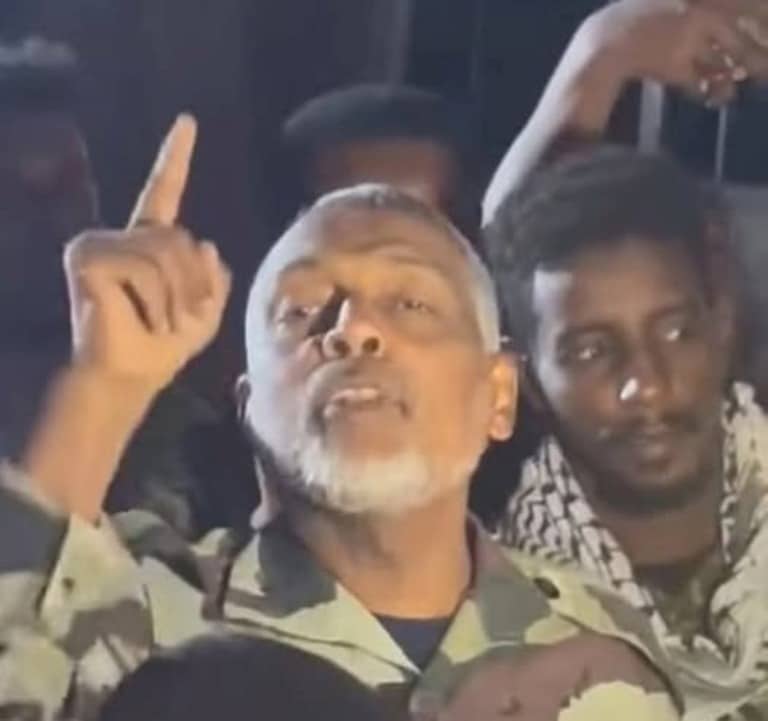
March 15, 2026 (KHARTOUM) – Sudanese authorities on Sunday arrested Enagi Abdullah, a prominent Islamist leader and a commander in the paramilitary groups fighting alongside the army, according to associates and fellow militia leaders.
The arrest follows a controversial speech Abdallah delivered on March 3 at a Ramadan gathering. Addressing a crowd of military volunteers and Islamist-leaning fighters, he declared his group’s explicit support for Iran in its confrontation with Israel and the United States while reiterating strong backing for the Palestinian movement Hamas.
General Abdel Fattah al-Burhan, the commander-in-chief of the Sudanese Armed Forces, had previously disavowed the group following those remarks. Burhan stated that the military would not allow any political entity to speak on its behalf and ordered legal measures against those attempting to represent the army’s official position.
El-Fadil Ali, a leader within the volunteer forces known as the Popular Resistance and a close associate of Abdullah, confirmed the detention on Sunday. Ali expressed concern over the fate of justice in Sudan and described the arrest as a direct reaction to Abdullah’s vocal support for Islamic causes against what he termed “Zionist-American” alliances.
Ali characterized Abdullah as a veteran commander who had recently returned from the front lines of the conflict against the Rapid Support Forces. He warned that detaining such a high-profile figure during an active war could demoralise the volunteer fighters who have mobilised to support the army during its current operational challenges.
Known among Islamist circles as the “Amir of the Mujahideen,” Abdallah rose to prominence as a member of the “Dabbabin,” or tank-hunters. These were specialized Islamist volunteer units that fought against southern rebels during the civil wars of the 1990s under the government of ousted President Omer al-Bashir.
Following a 1999 schism within Sudan’s Islamist movement, Abdallah joined the Popular Congress Party led by the late Hassan al-Turabi. Despite his history of political opposition to various administrations, he mobilized his followers to support the regular army immediately after the outbreak of the current war in April 2023.
The arrest coincides with a significant shift in international pressure on Sudan’s paramilitary factions. On March 9, the United States designated the Sudanese Muslim Brotherhood and the Al-Baraa bin Malik Brigade as Specially Designated Global Terrorists.
Washington has accused these groups of having links to Iran and undermining Sudan’s stability through violence. The sanctions, which officially come into effect on March 16, aim to isolate these paramilitary groups as the international community seeks to prevent the regionalization of the Sudanese conflict.
Observers suggest the timing of the arrest indicates a calculated move by the military leadership to distance itself from sanctioned Islamist elements. By detaining Abdallah, the army may be signalling to international powers that it remains a professional national institution, independent of ideological militias.
The move also highlights the delicate balance Burhan must maintain between utilizing Islamist manpower on the battlefield and managing the diplomatic fallout of their presence. Recent reports of Iranian-made drones being used by the Sudanese army have already drawn scrutiny from regional and Western powers.
Abdullah’s detention could trigger internal friction within the pro-army coalition. The Popular Resistance is a loose network of tribal and ideological groups, and the targeting of one of its most senior ideological figures may create a rift between the formal military command and its auxiliary forces.
As the war enters its third year, the internal politics of the Sudanese Armed Forces’ coalition remain a critical factor in the country’s trajectory. The government has yet to issue a formal statement regarding the specific charges Abdullah faces or the expected duration of his detention.