
Starlink offers fragile digital lifeline for Darfur’s displaced
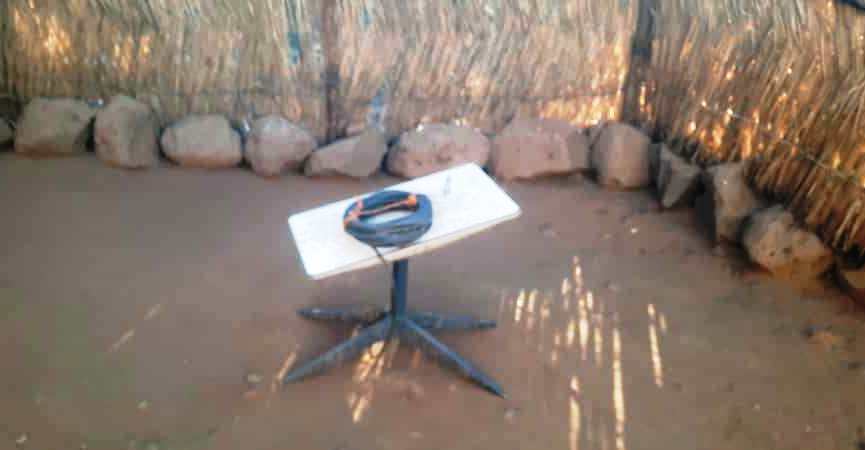
March 2, 2026 (TAWILA) – Only 68 kilometres west of the inferno in El Fasher, in the relatively quiet town of Tawila, the daily scene of displacement transforms into a different kind of ritual. Inside a modest “rakuba,” a traditional shelter built from tree trunks and straw, dozens of displaced people sit in dead silence, eyes fixed on their humble phone screens, waiting.
They are not waiting for flour, though hunger gnaws at their children’s stomachs. They are not waiting for medicine, though the sick lie on the dirt in neighbouring tents. They are waiting for something else: a green light to suddenly appear on their screens, signalling that the Wi-Fi connected to a Starlink device is working again.
The signal comes and goes, and sometimes they wait for minutes just to send a short voice message, but it is better than nothing, says Abubakr Adam, a displaced person from the Al-Radif neighbourhood in El Fasher. He crouches in a corner of the shelter, clutching an old phone with a shattered screen.
For months, specifically since the Rapid Support Forces (RSF) took control of El Fasher, all means of communication have been cut off for hundreds of thousands of residents trapped inside the city and for those who managed to flee to Tawila and the surrounding villages. The four telecommunications companies operating in Sudan—Zain, MTN, Sudani, and Canar—have completely ceased operations across Darfur since the war broke out, due to the destruction of towers, fuel shortages, or areas falling outside state control.
In this echoing void, Starlink devices, operated by Elon Musk’s SpaceX, have emerged as the sole solution to break the isolation. Suddenly, the sky has become the only window through which the people of Darfur can look out at the world.
Without Starlink, they would be in the Stone Age, Abubakr says bitterly. He adds that he does not know if his family in El Fasher are still alive or dead. His daughter, her husband, and their five children are trapped there. The last news he received was 20 days ago when they were taking shelter in a school surrounded by militias, but he does not know what has happened since.
At the entrance of the shelter, a small handwritten sign hangs stating that Starlink costs 1,000 Sudanese pounds per hour. It is a staggering price in a region where the currency has collapsed, and income has vanished. Yet, paradoxically, dozens of displaced people wait their turn to pay it.
Saleh Yaqoub, the owner of the shelter, told Sudan Tribune that people are forced into this as they have no other choice. He noted that while some other places charge 1,500 pounds for an hour, he tries to make it easier for people by charging 1,000. He added that the connection often lasts no more than four hours for that amount, and sometimes he accepts 500 pounds if the situation is very dire. He says he does not profit much but feels it is a mission.
Yaqoub pays $120 a month for the basic package, plus extra fees for speed. The devices are brought in from Libya or Chad via smuggling. He says everything is difficult, but the people’s suffering is many times worse than his own.
In another corner of the shelter, 55-year-old Khadija Mohammed sits weeping quietly. After 45 minutes of waiting, she managed to make a voice call to her eldest son trapped in El Fasher. She says he was crying and told her that hunger was killing them, and they had no money for water or medicine. He told her his young children were dying before his eyes, and he could do nothing.
Khadija sighs deeply, asking what she can say to him. She is in a tent without a proper roof and eats once a day. She says the only difference is that she can breathe freely, while they are in a massive prison called El Fasher. She cried for 40 minutes after the call and then returned to the shelter, hoping she might hear her grandson’s voice before he dies.
Using Starlink in war zones is not merely a technical luxury but carries significant risks. Osama Hassan, a network engineer displaced from El Fasher to Tawila, explains that Starlink works via satellites, which means every connection passes through ground stations outside Sudan. Theoretically, any party with technical capability can monitor these communications, especially if they possess advanced surveillance tools.
Hassan adds that in war zones, geolocation becomes a matter of life or death. If the RSF or any other party can track device signals, they can target activists, journalists, and even ordinary civilians. He recounts an incident from weeks ago where some displaced people told him they received threatening messages after using the internet, accusing them of communicating with the army. He says they do not know how they were identified, but the possibilities are many.
Despite the danger, Starlink remains the only tool enabling activists and journalists to document what is happening inside El Fasher. Through intermittent connections, new testimonies arrive daily from the besieged city, including distress messages from detainees dying of cholera and reports of summary executions.
An aid activist using the pseudonym Abubakr told Sudan Tribune that while some trapped in El Fasher relied on paper notes smuggled out, they can now document violations almost instantly thanks to Starlink. They have sent photos of hundreds of bodies, testimonies from survivors of executions, and videos of secret dealings inside detention centres. However, he notes that most displaced people do not own modern smartphones and cannot afford internet access, meaning many testimonies are lost.
Since El Fasher fell to the RSF, thousands of residents have fled toward relatively safer areas, primarily Tawila. Humanitarian reports indicate that more than 25,000 people have reached the town alone, while thousands more are scattered across camps in neighbouring villages.
However, reaching Tawila was not the end of the tragedy. The camps here lack basic necessities such as clean water, food, medicine, and shelter. Yet, the displaced insist on staying in touch with those they left behind.
Asia Nour, a 30-year-old displaced woman from the Al-Salam neighbourhood, says the last time she spoke with her aunt in El Fasher, the aunt was crying and saying all the neighbours had died. Nour has not heard from her in 10 days and fears she may have died, or that the Starlink device they were using was broken or stolen.
Despite repeated warnings, the international community remains unable to provide a tangible response to save the residents of El Fasher and the displaced in Tawila. Humanitarian aid does not arrive, safe corridors are closed, and communications are nearly non-existent.
An aid coordinator in Tawila says Starlink is the only thing connecting these people to life, but it is not a solution. He notes that people are dying of hunger and disease, and most do not even have the price of half an hour of internet. He warns that they are facing a major humanitarian catastrophe while the world is asleep.
In the shelter, dozens still wait. Some whisper prayers while others stare at the sky as if searching for the satellite that might carry the voice of a lost son. An elderly woman says softly that they do not ask for much, only to be reassured about their children before they die. She says even death becomes easier when you know those you love are okay.
In the fallen city of El Fasher, in overcrowded Tawila, and in every corner of Darfur, Starlink devices remain like messages in bottles, floating on the surface of an ocean of death and carrying the last words of survivors before the silence swallows them.